
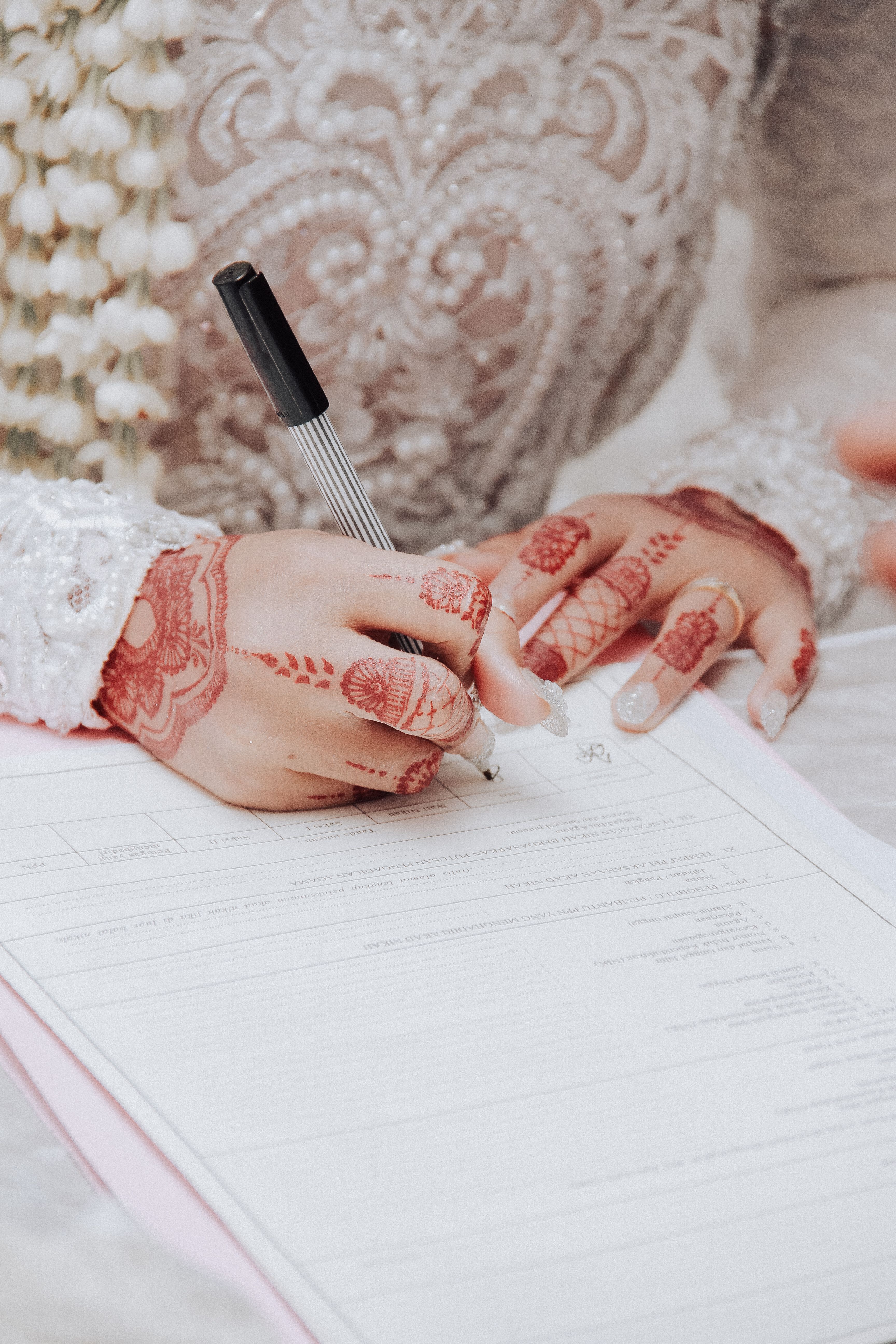

The mahr amount is decided by the bride — it is her right, and hers alone, to determine what she would like to receive. Her family may advise, and the groom must be able to genuinely provide it, but neither her father nor her wali can set the mahr on her behalf without her genuine input and agreement. As for validity: a nikah contracted without any mahr discussion is considered irregular by most scholars but is not automatically void — however, the mahr obligation does not disappear. It remains the wife's right and must be determined and paid.
Who has the right to set the mahr amount?
The mahr belongs to the bride. It follows, then, that the right to determine it belongs to her.
This is stated explicitly in the Quran: "And give the women their mahr as a free gift." (Surah An-Nisa, 4:4) The address is to the husband — give the women their mahr. Not give it to their families. Not agree it with their fathers. Give it to them.
Classical scholars across all four major schools of Islamic jurisprudence are consistent on this point. The wali's role in the mahr conversation is advisory and protective — he may ensure the mahr is appropriate and that the groom can genuinely provide it. He does not have the right to set it on her behalf, waive it on her behalf, or accept a lesser amount than she wants without her genuine agreement.
("Al-Kasani in Bada'i al-Sana'i states directly that the mahr is a right established for the bride — not for her guardian. A wali who agrees a mahr without the bride's knowledge or against her stated preference has acted outside his authority. The contract may still stand depending on the madhab, but the wali has exceeded the protective function wilayah is designed to serve. The mahr remains hers — at the amount she would have chosen, not the amount he agreed.")
In practice, the mahr conversation is often conducted between families — fathers, uncles, and representatives on both sides negotiating an amount as part of the broader marriage process. This is culturally common. It becomes Islamically problematic when the bride's own preference is never sought, when she is pressured to accept less than she wants, or when the family treats the mahr as a family matter rather than a personal right belonging to her alone.
Can a father or wali decide the mahr without asking the bride?
No — not validly. A father or wali who agrees a mahr amount on the bride's behalf without genuinely seeking her input and agreement has not fulfilled the Islamic requirement, even if the nikah proceeds.
The mahr is not a negotiation between two families. It is a gift from the husband to the wife. The wife is the party whose preferences determine what the gift should be. Her family's involvement is appropriate and often valuable — experienced parents can advise on what is reasonable, on the groom's genuine capacity, and on how to approach the conversation. But advising is not deciding.
The situation that Islamic scholars consistently flag as problematic: a bride who never knew her mahr amount because her father agreed it without telling her, or who felt pressured to accept a token amount because "the family had already agreed." In both cases, the mahr right has been violated in spirit even if the nikah is technically valid.
("A 2023 report by the Muslim Women's Network UK found that 41% of Muslim women surveyed did not know their mahr amount at the time of their nikah — it had been agreed between families without their direct knowledge or involvement. A further 23% knew the amount but felt they had no genuine ability to request anything different. In total, nearly two-thirds of respondents had not exercised the mahr right that Islamic law explicitly gives them. The gap between Islamic principle and community practice on this question is significant.")
Is a nikah valid without mahr?
A nikah contracted without any mahr being agreed is the subject of genuine scholarly discussion — and the positions across the major schools differ in an important way.
The majority position — Maliki, Shafi'i, and Hanbali schools: A nikah contracted without mahr is irregular but not void. The nikah itself stands. What does not stand is the absence of the mahr obligation — the wife's right to mahr remains intact regardless of whether it was discussed at the nikah. In this case, she is entitled to mahr al-mithl — the customary mahr appropriate to a woman of her standing, background, and community — determined after the fact.
The Hanafi position: Broadly consistent with the majority — the nikah is valid, and the mahr obligation persists. A nikah that explicitly stipulates no mahr — where both parties formally agree that no mahr will be given — is also valid in the Hanafi school, with the wife entitled to mahr al-mithl if the marriage is consummated, regardless of what was agreed.
The practical conclusion across all schools is the same: mahr cannot be eliminated. A nikah without mahr discussion does not remove the wife's right. It simply creates a debt that has not yet been quantified — and the Islamic courts or scholars will determine a fair amount if it is not agreed.
("The concept of mahr al-mithl — the equivalent mahr — is one of the more sophisticated protections in Islamic family law. It functions as a floor: no matter what happens during the nikah process, the wife cannot end up with less than what a woman of her standing would customarily receive. It prevents the mahr from being eliminated through oversight, family pressure, or deliberate omission. Ibn Qudama documents the methodology for calculating mahr al-mithl in Al-Mughni — considering the mahrof her sisters, paternal aunts, and women of comparable status in her community.")
What if the groom cannot afford what the bride wants?
This is the practical tension at the heart of many mahr conversations — and Islamic guidance addresses it with characteristic directness.
The Prophet ﷺ said: "The best mahr is the easiest." (Abu Dawud, authenticated by Al-Albani) Scholars consistently interpret this as the mahr that is genuinely within the groom's means, given willingly, and fulfilled completely — not the smallest possible amount, and not a dramatic sum promised and never paid.
A groom who cannot afford what the bride has asked for has two honest options: discuss it openly and reach a genuine agreement on an amount he can actually provide, or offer something non-monetary of genuine value — a skill, a service, property — that carries real worth to her.
What is not an honest option: agreeing to an amount he cannot pay in order to complete the nikah, intending to worry about it later. A deferred mahr is a real debt — not a social gesture that disappears if the marriage continues. Agreeing to a mahr you have no realistic plan to pay is both an Islamic obligation you are not fulfilling and a financial deception toward your spouse.
The conversation that resolves most mahr tension: both people coming in with honest information. She knows what she genuinely wants and why. He knows what he can honestly provide and when. The gap, if there is one, is then a real conversation between two honest people — not a performance for families or a negotiation where both sides are hiding their actual positions.
What if the bride wants a very high mahr the groom cannot pay?
Islam places no upper limit on mahr — but it does place a principle of honesty and genuine capacity at the centre of the obligation.
A very high mahr that the groom cannot realistically pay produces one of two outcomes: either it becomes a deferred mahr that follows him as an unpaid debt for the duration of the marriage, or it becomes a source of ongoing conflict and resentment. Neither serves the marriage.
The Prophet ﷺ's guidance — "the best mahr is the easiest" — is directly relevant here. Not the most impressive. Not the one that satisfies family expectations. The one given genuinely, within honest capacity, and fulfilled completely.
Some scholars advise that a bride requesting an amount she knows the groom cannot pay is itself contrary to the spirit of the mahr — using a sacred right as a financial barrier rather than a genuine expression of what she values. Others hold that her right is unconditional and the groom must either meet it or honestly negotiate. The practical wisdom from all positions is the same: the mahr should be a genuine agreement between two people who are honest about what they want and what they can provide.
("Sheikh Ibn Uthaymin addressed the question of excessive mahr in his fatawa, noting that a mahr set primarily for social performance — to impress families or demonstrate status — rather than genuine value to the bride contradicts the Prophetic guidance toward ease. He distinguished between a bride who genuinely values a specific amount and one whose family has set an amount for social reasons without her genuine input. The former is her right. The latter is a misuse of the mahr framework that harms both the marriage and the meaning of the right itself.")
Can the bride waive her mahr after the nikah?
Yes — but only under very specific conditions that Islamic scholars treat with great care.
A bride may voluntarily waive all or part of her mahr after the nikah. The Quran explicitly allows this: "But if they give up willingly to you anything of it, then take it in satisfaction and ease." (Surah An-Nisa, 4:4)
The key word is tibnan — willingly, freely, without pressure. Scholars across all schools are consistent: a waiver of mahr is only valid if it is genuinely free. A bride who waives her mahr because cultural norms expect her to, because her family expects her to, because she fears the consequences of not doing so, or because she did not understand she had a choice — has not waived willingly. The mahr remains her right.
The practice in some communities of immediately returning the mahr at the nikah — before the marriage has even begun, as a cultural gesture of generosity — is something scholars have flagged with concern. A right that is reflexively returned before it is genuinely held has not truly been exercised. If the return is genuinely her free choice, it is permissible. If it is social expectation dressed as choice, it is not.
How does Soul Deeds approach the mahr conversation?
Soul Deeds provides access to imams and Islamic advisors through in-app booking — for couples who want knowledgeable Islamic guidance on the mahr conversation before it happens, rather than discovering they navigated it badly afterward.
The mahr conversation is one of the first genuinely difficult conversations a couple has to navigate together. How they do it — with honesty, with respect for her right, with his honest assessment of what he can provide — is a preview of how they will navigate difficult conversations in the marriage itself.
Soul Deeds' Community Giving Circle model creates the context in which two people can already know something real about each other's character before the mahr conversation begins. A man who shows up honestly, fulfils his commitments, and treats everyone around him with genuine respect in a service setting is already demonstrating the qualities that make the mahr conversation straightforward — because his word means something before it is tested by anything important.
Frequently Asked Questions
Can a father accept a lower mahr than the bride wants? Not without her genuine agreement. A father or wali may advise, negotiate, and facilitate the mahr conversation — but the right belongs to the bride. A mahr agreed by her father without her genuine knowledge and consent has not been properly determined in Islamic terms. The wife retains her right to mahr al-mithl — the customary equivalent — if what was agreed on her behalf was less than what she would have chosen.
What is mahr al-mithl and when does it apply? Mahr al-mithl is the customary mahr equivalent — the amount appropriate to a woman of her standing, background, and community, determined by reference to the mahrof comparable women in her family and community. It applies when no mahr was specified at the nikah, when a clearly inadequate token mahr was agreed, or when the nikah stipulated no mahr at all. In all these cases, the wife does not end up with nothing — she is entitled to the customary equivalent.
Is it permissible for a bride to ask for a non-monetary mahr like a house or land? Yes — property, gold, a specific item, or anything of genuine agreed value qualifies as mahr. The key conditions are that it is genuinely valuable to her, that the groom can actually provide it, and that the terms are clearly agreed — if it is property, the specific property and its transfer must be defined. Vague promises of non-monetary mahr create the same problems as unpaid deferred cash mahr.
Is Soul Deeds a dating app? No. Soul Deeds is a Muslim matrimonial platform for people seriously seeking marriage. Members are verified, and connections form through shared community service projects rather than swiping.
Can I speak with an imam through Soul Deeds about mahr? Yes. Soul Deeds includes in-app booking with advisors — imams, scholars, and marriage and relationship coaches — who can provide personalised guidance on mahr and every other aspect of the marriage process.
Is Soul Deeds free? Yes — Soul Deeds is free to join, on iOS, Android, and the web.