
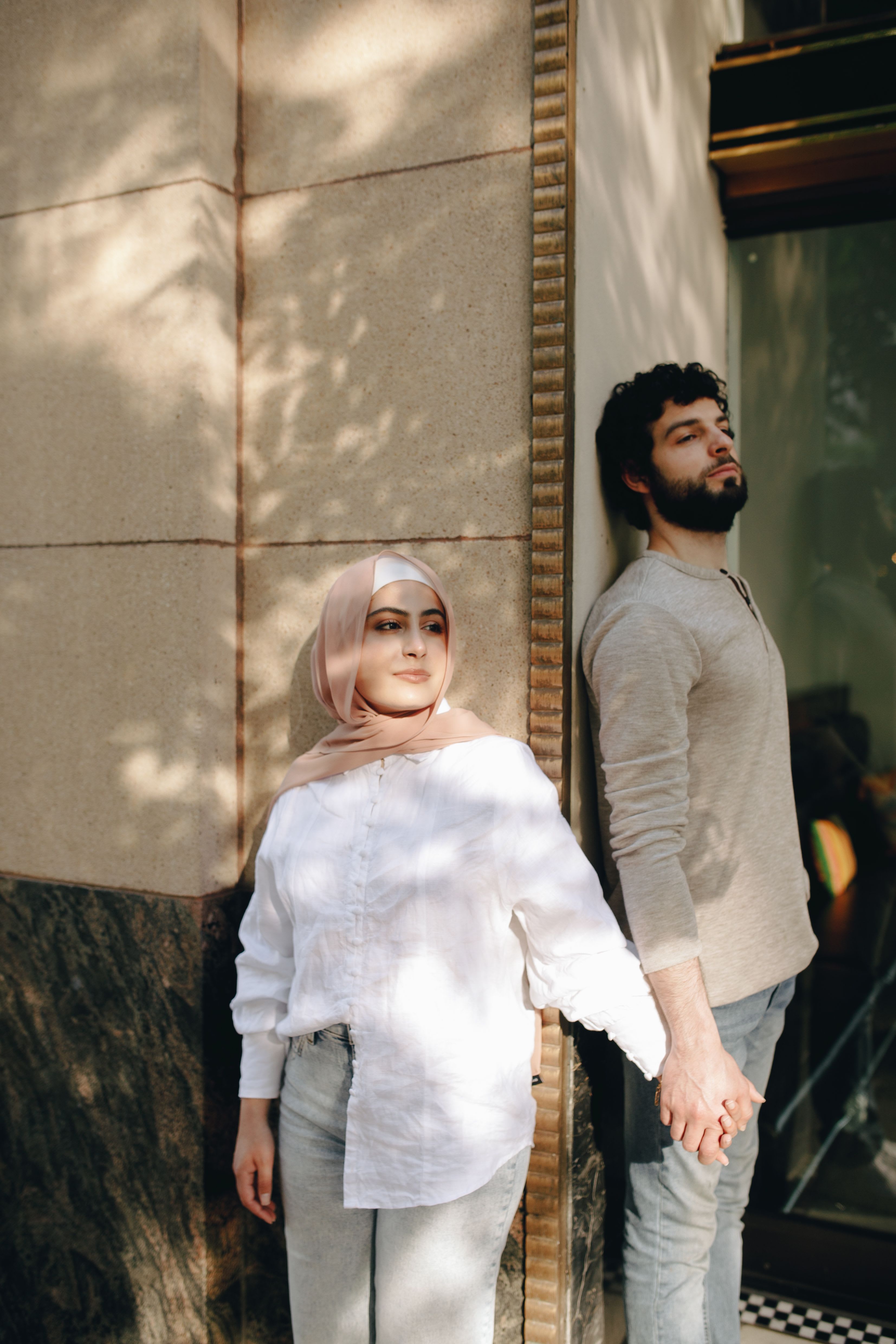

Open any Muslim social media space right now and you will find the same thing.
A post about Muslim women's struggles — the comments fill with Muslim men explaining why the women are wrong. A post about Muslim men's struggles — the comments fill with Muslim women explaining why the men deserve it. A discourse about marriage expectations — and within minutes it has become a courtroom, two sides presenting evidence against each other, everyone certain the other side is the problem.
The Muslim gender war is everywhere online. It is loud, it is exhausting, and it is — from an Islamic standpoint — completely manufactured.
Islam never positioned men and women as opponents. Not once. Not in the Quran. Not in the Sunnah. Not in fourteen centuries of Islamic scholarship. The entire framework of gender conflict that has been imported into Muslim discourse from secular culture has no roots in the deen whatsoever.
What Islam actually says is something so much more beautiful — and so much more useful — than anything the internet is currently offering.
This is that reminder.
Key Takeaways
- The Quran explicitly describes men and women as counterparts, allies, and partners — not opponents
- "Verily women are counterparts of men" is an authentic hadith of the Prophet ﷺ — establishing legal, spiritual, and relational equality of standing
- Multiple Quranic ayat describe the man-woman relationship in terms of mutual completion, shared origin, and reciprocal love
- The gender war discourse online is a distraction from what Islam actually calls Muslim men and women toward
- Soul Deeds exists because Muslim men and women are meant to find each other — as allies, partners, and spouses
What the Quran Actually Says About Men and Women
Before anything else — the source. Because the Quran speaks on this directly, repeatedly, and beautifully. And most of the people engaged in Muslim gender war discourse have not sat with these ayat recently.
"And We Created You in Pairs" — Surah An-Naba 78:8
"And We created you in pairs."
This is the foundational statement. Before roles, before responsibilities, before any discussion of differences — Allah declares the essential nature of the relationship between men and women. Pairs. Zwawj. Two things made for each other, from the same origin, toward the same destination.
A pair is not a hierarchy. A pair is not a competition. A pair is two complementary things that together form something neither could be alone.
"They Are Clothing for You and You Are Clothing for Them" — Surah Al-Baqarah 2:187
"They are clothing for you and you are clothing for them."
This ayah is describing spouses — but the principle it establishes runs deeper than marriage. Clothing protects. Clothing covers vulnerabilities. Clothing is intimate — it knows the shape of the person wearing it. And crucially: clothing is mutual here. Not "he is clothing for her." Both, for each other. Equal in their function of protection, equal in their intimacy, equal in their necessity to each other.
"And of His signs is that He created for you from yourselves mates that you may find tranquility in them, and He placed between you affection and mercy" — Surah Ar-Rum 30:21
"And of His signs is that He created for you from yourselves mates that you may find tranquility in them, and He placed between you affection and mercy."
Allah is describing the man-woman relationship — specifically the spousal relationship — as one of His signs in the universe. The same category as the creation of the heavens and the earth, the alternation of night and day, the rain that brings life to dead land. This relationship — between a man and a woman, characterised by sakina, mawadda, and rahma — is a sign of Allah's existence and mercy.
You do not make a sign of Allah into a battlefield.
("The word 'sakina' — translated as tranquility — carries specific weight in Quranic usage. It appears elsewhere to describe the peace Allah sent down upon the Prophet ﷺ and the believers in moments of great trial. That Allah uses the same word to describe what He placed between spouses is a statement about the depth and sacredness of the relationship. It is not a description of convenience or utility. It is a description of divine peace, placed between two people, as a mercy.")
"And their Lord responded to them: Never will I allow to be lost the work of any worker among you, whether male or female; you are of one another" — Surah Al-Imran 3:195
"Never will I allow to be lost the work of any worker among you, whether male or female; you are of one another."
Ba'dukum min ba'd. You are of one another. This ayah was revealed in response to Umm Salamah (RA) asking Allah whether women's deeds would be rewarded equally to men's. The answer was not a qualification. It was a declaration: you are of one another. Same origin. Same standing before Allah. Same accountability. Same reward.
The gender war requires a premise that Islam refuses to grant: that men and women are fundamentally in competition, that one's gain is the other's loss, that the flourishing of one comes at the cost of the other. This ayah dismantles that premise completely. You are of one another.
"And do not wish for that by which Allah has made some of you exceed others" — Surah An-Nisa 4:32
"And do not wish for that by which Allah has made some of you exceed others. For men is a share of what they have earned, and for women is a share of what they have earned."
This ayah directly addresses the comparison and competition dynamic. Do not covet what the other has. Each has their own. Each earns their own. The instruction is not to look sideways at the other gender and resent what they have been given. It is to look forward, toward what you yourself are called to earn and build.
"It is He who created you from one soul and created from it its mate that he might dwell in security with her" — Surah Al-A'raf 7:189
"It is He who created you from one soul and created from it its mate that he might dwell in security with her."
One soul. A single origin. The mate is not a separate creation from a different origin — she is created from the same nafs, the same essential being. The distance between men and women that the internet insists on is, from a Quranic standpoint, not a natural state. It is a distortion of something that began as one.
What the Prophet ﷺ Said — Directly
The hadith on this is unambiguous and has been authenticated by hadith scholars across centuries.
The Prophet ﷺ said: "Verily women are the counterparts (shaqa'iq) of men." (Abu Dawud, authenticated)
The word shaqa'iq is precise and important. It means the other half of a split thing — like the two halves of a date split down the middle, each carrying the same nature, the same substance, the same origin. Counterparts. Not subordinates. Not opponents. Not a lesser category. The other half of the same thing.
This hadith was not a social commentary. It was a legal ruling — the Prophet ﷺ was establishing that religious obligations applicable to men apply equally to women unless specifically differentiated. It was a statement about essential equality of standing before Allah and before Islamic law.
("The Arabic word shaqa'iq has been examined extensively by classical hadith scholars and linguists. Ibn al-Athir in Al-Nihayah fi Gharib al-Hadith defines it as 'the half of something that has been split' — establishing that the Prophet ﷺ was describing men and women not as complementary opposites but as two halves of a single reality. This framing makes competition between them not just inadvisable but conceptually incoherent — you cannot be at war with your own other half.")
He also said: "The best of you are those who are best to their wives." (Ibn Majah, authenticated) And: "A believing man should not hate a believing woman. If he dislikes one of her characteristics, he will be pleased with another." (Muslim)
The Prophetic model of manhood was not dominance, dismissiveness, or competition with women. It was service to them, respect for them, and the active cultivation of love and mercy in relationship with them.
Where the Muslim Gender War Actually Comes From
It does not come from Islam. It needs to be said directly: the Muslim gender war is not an Islamic phenomenon. It is a cultural import.
The secular West has been engaged in a gender war — in various forms, under various banners — for decades. That conflict has its own history, its own wounds, its own legitimate grievances and its own distortions. It has produced real conversations about equality and real extremes of misogyny and misandry.
And Muslim communities — particularly diaspora Muslim communities deeply embedded in Western media culture — have absorbed this conflict wholesale, dressed it in Islamic vocabulary, and presented it as though it were rooted in the deen.
It is not.
("A 2024 Pew Research analysis of social media content in Muslim-majority digital spaces found that gender conflict content — posts framing Muslim men and women as adversaries with competing interests — had increased by over 300% between 2019 and 2024. The research noted that the rhetorical patterns in Muslim gender war content closely mirrored secular men's rights and feminist discourse, suggesting significant cross-pollination rather than Islamic-origin framing. In other words: Muslim communities did not generate this conflict from within their own tradition. They imported it.")
The incel-to-Islamic-spaces pipeline is real. The feminist-discourse-reframed-in-Islamic-vocabulary pipeline is equally real. Both take genuine pain — and there is genuine pain on both sides, real experiences of being wronged, real failures of community and culture — and channel it into an adversarial framework that Islam has never endorsed.
The pain is real. The framework is borrowed. And the framework is making the pain worse.
What the Internet Is Actually Doing — And Why It Works
The algorithm does not care about Muslim flourishing. It cares about engagement. And nothing generates engagement like conflict.
A post about Muslim men and women working together, building community, finding love through shared purpose — it gets some likes. A post positioning Muslim men as the problem, or Muslim women as the problem — it generates hundreds of comments, shares, quote posts, responses, counter-responses. The machine rewards the conflict. It amplifies the most extreme voices on both sides. It creates the impression that the extreme positions are the majority — when most Muslim men and women are simply living their lives, trying to be good Muslims, and not particularly interested in being soldiers in someone else's discourse war.
("Research from the MIT Media Lab (2022) found that emotionally provocative content — particularly content generating moral outrage — spreads three to six times faster on social media platforms than neutral content. Content framing groups as opponents consistently outperforms content framing them as allies. The algorithm has a structural preference for conflict that is independent of the content's truth or usefulness.")
Understanding this does not make the conflict less painful. But it does make it easier to step back from. The Muslim gender war is, in significant part, a product of a machine that profits from Muslim communities being at each other's throats. Choosing not to participate is not passivity. It is refusing to be used.
What Islam Actually Calls Muslim Men and Women Toward
Not war. Not competition. Not a hierarchy of grievance where whoever has suffered more gets to dominate the discourse.
Wilayah — mutual guardianship and support.
The Quran says: "The believing men and believing women are allies (awliya') of one another." (Surah At-Tawbah, 9:71) The word awliya' means guardians, protectors, friends — those who are in each other's corner. The ayah continues: they enjoin what is right, they forbid what is wrong, they establish prayer, they give zakat, they obey Allah and His Messenger. Together. As allies.
This is the Islamic vision of the relationship between Muslim men and women. Not opponents presenting evidence against each other online. Allies — enjoining good, forbidding wrong, building something together that serves Allah.
Rahma — mercy toward each other.
The Prophet ﷺ described the believers in their mutual mercy, love, and compassion as one body — when one part is hurt, the whole body responds with fever and sleeplessness. (Bukhari and Muslim) That body includes men and women both. The pain Muslim women experience is pain the Muslim community should respond to as a body. The pain Muslim men experience is pain the Muslim community should respond to as a body. Not as ammunition for the other side. As a reason for collective response.
Zawj — pairing, completion, return to origin.
The Quranic vision of the relationship between men and women is ultimately about completion — not the completion of incompleteness, as if either is a half-person without the other, but the coming together of two whole people who together become something more than either alone. The pair that Allah describes in Surah An-Naba is the natural state. The conflict is the distortion.
This Is What Soul Deeds Is Built For
Soul Deeds exists because Muslim men and women are meant to find each other.
Not as adversaries who have finally agreed to a truce. Not as strangers navigating a transactional rishta process. As allies — people who share values, who share a commitment to service, who show up for the same things and in doing so discover that the person beside them at a volunteer shift is someone worth knowing more deeply.
The Community Giving Circle model works precisely because it puts Muslim men and women in the same space, doing something that matters, as equals in purpose. Not performing for each other. Not evaluating each other against a checklist. Serving alongside each other — and in that service, finding out who each other actually is.
("The research on intergroup contact — the conditions under which people from different groups develop genuine positive relationships — consistently identifies shared purposeful activity as the most effective mechanism. When two people are working toward a common goal that neither can achieve alone, the us-versus-them framing dissolves. Community service is the oldest and most reliable form of this contact. Soul Deeds applies it to the specific context of Muslim singles — creating the conditions for genuine alliance before romantic consideration even begins.")
That alliance — built on shared values, shared service, and mutual recognition of each other's full humanity — is the starting point that the Quran describes. You are of one another. Two halves of the same thing, finding each other not through conflict but through what they both care about.
The internet wants Muslim men and women fighting.
Allah created them as pairs.
The choice of which story to live in is still ours.
Frequently Asked Questions
Does Islam say men and women are completely equal in every way?
Islam affirms the equal spiritual standing of men and women before Allah — same accountability, same reward, same origin, same destination. It also acknowledges that men and women have different roles and responsibilities in specific contexts — financial obligation in marriage, inheritance in certain situations, testimony in specific legal cases. These differences are not a hierarchy of worth but a differentiation of function — the same way the right hand and the left hand are equal in value and different in function. The Quran explicitly states: "And do not wish for what Allah has made some of you exceed others in" — the instruction is not to flatten difference but to stop weaponising it.
What about the real grievances Muslim women and men have against each other?
They are real and they deserve to be addressed — honestly, within an Islamic framework, with the goal of repair rather than point-scoring. Muslim women have genuine experiences of being wronged within Muslim communities and Muslim marriages. Muslim men have genuine experiences of being dismissed, unfairly characterised, and held to standards that are then not reciprocated. Both sets of experiences can be true simultaneously. The Islamic response to genuine grievance is not a discourse war — it is accountability, repair, and the cultivation of the mercy and justice the Quran calls both genders toward.
How do I disengage from Muslim gender war content online without ignoring real issues?
There is a difference between engaging with real issues and engaging with manufactured conflict framed as real issues. Content that centres Muslim women's or men's actual experiences — their struggles, their spiritual journeys, their practical challenges — is worth engaging with. Content designed to generate outrage against the other gender, that frames every issue as evidence of the other side's fundamental wrongness, is the algorithm doing its work. Recognising the difference — and choosing the first over the second — is not avoidance. It is discernment.
What does Islam say about men who genuinely have negative views of women or women who genuinely have negative views of men?
The Prophet ﷺ said: "A believing man should not hate a believing woman. If he dislikes one of her characteristics, he will be pleased with another." (Muslim) Generalised contempt for either gender — the posture that underlies much of the online gender war — is incompatible with Islamic character. It is also incompatible with accurate observation: no gender is monolithic, no group is defined by its worst members, and the generalisation required to sustain gender war discourse is a failure of both justice and intelligence.
How does Soul Deeds address the gender war dynamic?
By replacing the adversarial framework with a collaborative one before any matrimonial consideration begins. When two people have spent time working toward a shared purpose — in a Soul Deeds Community Giving Circle — they have already experienced each other as allies. The default that the algorithm tries to install — suspicion, competition, grievance — has already been replaced by something more accurate and more Islamic. They have seen each other serve. That is a better foundation for any relationship, romantic or otherwise, than anything the internet is currently offering.
Conclusion
The internet wants Muslim men and women fighting.
The algorithm profits from it. The extreme voices on both sides are amplified by it. And quietly, gradually, Muslim communities have absorbed a framework for the relationship between men and women that has nothing to do with Islam and everything to do with a secular culture war that was never ours to fight.
The Quran is clear. The Prophet ﷺ is clear. Muslim men and women share one origin, one standing before Allah, one destination, and — when they find each other — one home built on sakina, mawadda, and rahma.
Ba'dukum min ba'd. You are of one another.
Shaqa'iq. Counterparts. Two halves of the same thing.
Zawj. Pairs. Created as pairs. Meant to find each other.
This is the Islamic story of men and women. It was never a war. It was always an alliance.
And it still is — for anyone who chooses to live in it.