
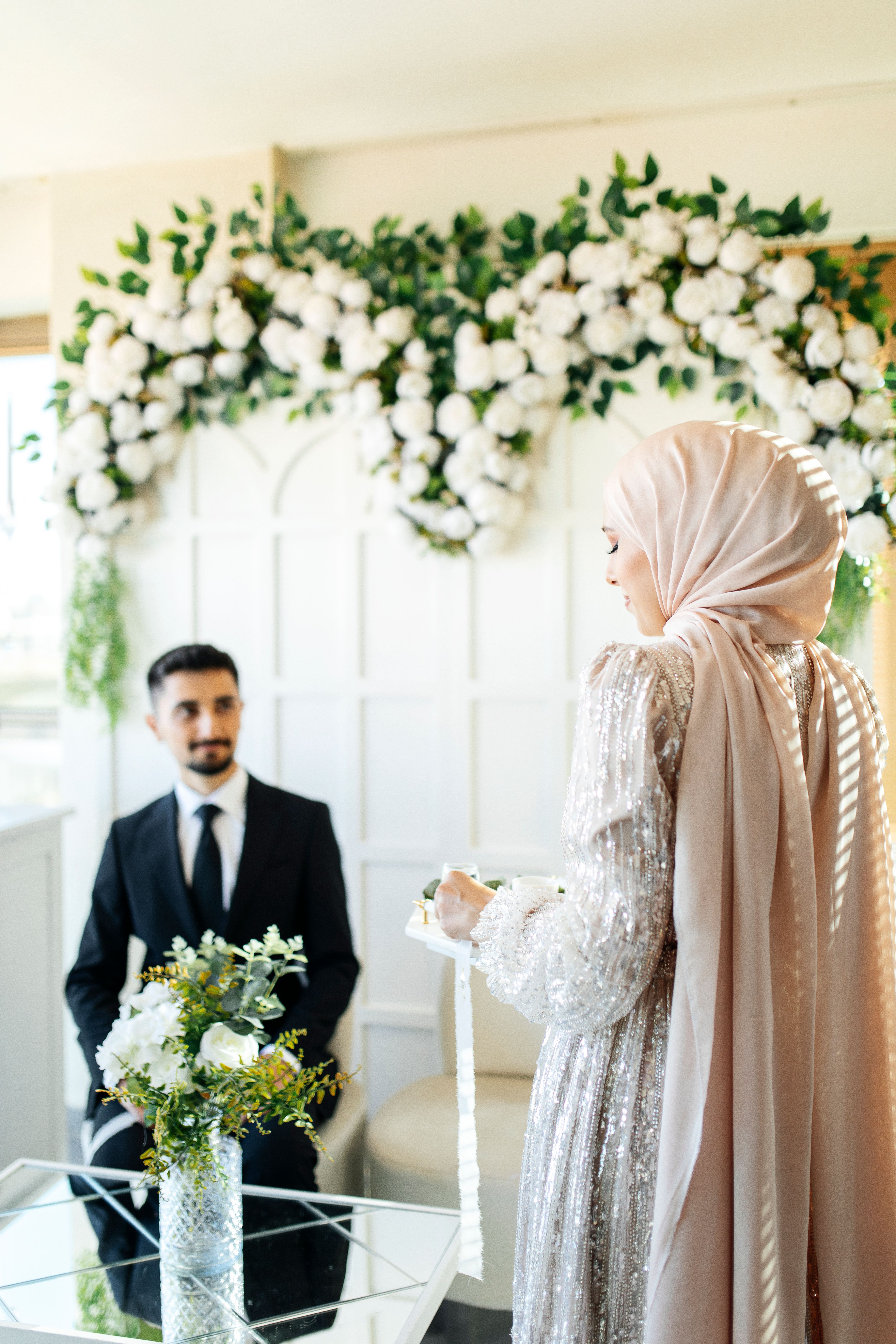

The mahr can be anything of genuine value that the bride genuinely wants and the groom can honestly provide — money, gold, property, a skill, or even teaching her something. There is no fixed minimum or maximum in Islamic law. What matters is that it is agreed upon freely, belongs exclusively to the wife, and is something the groom will actually fulfil. The Prophet ﷺ said the best mahr is the easiest — meaning the one given willingly and completely, not the most impressive one promised and never paid.
What qualifies as mahr in Islam?
Mahr can take almost any form that has genuine value — it is not restricted to money or gold, though these are most common. The classical scholars agreed that anything permissible in Islam that can be owned, used, or benefited from qualifies as mahr.
Forms of mahr that Islamic scholars have affirmed across history:
Money. The most common form — a specific amount agreed upon before or at the nikah, paid in full or split into prompt and deferred portions.
Gold or jewellery. Widely used across Muslim cultures. The value should be agreed in specific terms — a weight of gold, a specific piece — rather than vaguely.
Property. A house, land, or a share in property. Less common in Western contexts but entirely valid.
A skill or service. The Prophet ﷺ accepted teaching a woman Quran as her mahr. An agreed period of teaching, professional service, or specific work can qualify — though contemporary scholars advise care in ensuring the value is clearly defined and the service genuinely deliverable.
Anything of agreed value. The essential condition is that it has real worth to her — not symbolic worth, not cultural expectation, but genuine value as she defines it.
("Ibn Qudama in Al-Mughni states that the scholars agreed on one principle above all others in mahr: it must be something that can be owned and benefited from. The form is secondary. The ownership — unconditional, belonging entirely to the wife — is primary. A mahr over which the wife does not have full, free disposal is not a valid mahr in Islamic law, regardless of how generous it appears.")
How much should the mahr be?
There is no minimum or maximum in Islamic law — and both extremes of this principle get misapplied regularly.
The misapplication of "no minimum": mahr set at a token amount — one dollar, one Quran — because "the amount doesn't matter." The amount does matter. A mahr should reflect genuine value. A token mahr that carries no real worth to the wife fulfils the letter of the requirement while missing its spirit entirely.
The misapplication of "no maximum": mahr set at an amount the groom cannot realistically pay — agreed upon for social performance, never actually fulfilled. This is worse than a modest mahr paid completely. A mahr is a debt until it is paid. Promising what you cannot deliver is not generosity. It is a financial obligation that follows the groom into the marriage and — if the marriage ends — becomes immediately due.
The Prophet ﷺ said: "The best mahr is the easiest." (Abu Dawud, authenticated by Al-Albani) Scholars consistently interpret this as: the mahr that is given genuinely, without strain, and fulfilled completely — not the smallest possible amount, and not a performance of wealth the groom does not have.
("A 2023 survey of Muslim married couples in the UK by the Muslim Council of Britain found that deferred mahr was unpaid at the time of divorce in over 60% of cases where it had been agreed. In the majority of these cases, the original mahr amount had been set primarily to satisfy family and community expectations rather than based on honest assessment of what the groom could actually provide. The mahr had functioned as a social performance at the nikah and a source of legal dispute at the divorce.")
What did the Prophet ﷺ give as mahr — and what was given to his daughters?
The Prophetic examples are some of the most instructive on this question — and they span a wide range that deliberately resists any single cultural norm.
Khadijah (RA) — the Prophet ﷺ gave twenty young she-camels as mahr. She was a wealthy woman of high standing, and the mahr reflected genuine value.
Aisha (RA) — her mahr was five hundred dirhams, paid by Abu Bakr (RA) on the Prophet's behalf. A significant but not extravagant sum by the standards of the time.
Fatimah (RA) — the Prophet ﷺ gave his daughter in marriage to Ali (RA), whose mahr was a coat of armour. When Ali could not find it, the Prophet ﷺ told him to give her his shield. A practical, honest assessment of what Ali could actually provide.
The woman whose mahr was teaching Quran — a man came to the Prophet ﷺ wanting to marry a woman but having nothing to give. The Prophet ﷺ asked if he knew any Quran. He did. "Marry her for what you know of the Quran." (Bukhari and Muslim) Teaching her what he knew became her mahr.
Umm Sulaym (RA) — accepted the Islam of Abu Talha (RA) as her mahr — his conversion was itself the gift she asked for. Scholars debate whether this applies beyond unique circumstances, but the principle it illustrates — that mahr can be deeply personal and non-monetary — is affirmed.
The range across these examples is deliberate. The Prophet ﷺ never standardised the mahr. He affirmed the principle — something of genuine value, given willingly, belonging to her — and left the form to the honest assessment of each situation.
Should the mahr be prompt or deferred?
Both are valid. Most mahrsin practice are split between a prompt portion (mu'ajjal) paid at or before the nikah and a deferred portion (mu'ajjal) agreed to be paid at a later date or upon the dissolution of the marriage.
The prompt mahr is the immediate gift — what she receives at the time of the nikah. The deferred mahr is a binding financial debt that does not disappear. It becomes due in full upon divorce or the death of the husband, whichever comes first. It is not symbolic. It is not a formality. It is a real, enforceable Islamic obligation.
("The deferred mahr functions in Islamic law as a financial protection for the wife — a guaranteed payment that ensures she is not left without resources if the marriage ends. Classical jurists including Al-Shafi'i and Malik treated the deferred mahr with the same legal seriousness as any other debt: it accrues, it is heritable by her estate if she dies before it is paid, and it cannot be extinguished without her explicit, free consent. Treating it as a theoretical number that will never actually be paid is a serious Islamic legal error.")
If a deferred mahr is agreed upon, the specific amount, conditions, and timing should be documented clearly — ideally in writing — at the time of the nikah. This is not a sign of mistrust. It is Islamic seriousness about a genuine obligation.
Can the wife waive or return her mahr?
Yes — entirely, partially, or not at all. But only if it is her free choice, made without pressure.
The Quran says: "But if they give up willingly to you anything of it, then take it in satisfaction and ease." (Surah An-Nisa, 4:4) The key word is willingly — tibnan. Scholars across all schools are consistent: a wife who returns her mahr voluntarily, without social pressure or expectation, has done something entirely permissible. A wife who returns it because cultural norms expect her to, or because her family expects her to, or because she felt she had no choice, has not given it willingly — and the mahr remains her right.
The practice in some communities of reflexively returning the mahr immediately after the nikah — as a demonstration of generosity or to avoid embarrassment — is not an Islamic expectation. It is a cultural norm that has been mistaken for one.
How do you have the mahr conversation without it becoming awkward?
The mahr conversation gets awkward for specific reasons — most of which are avoidable with the right framing.
It gets awkward when the groom treats it as a negotiation he wants to minimise. It gets awkward when the bride does not know her rights clearly enough to state them honestly. It gets awkward when family on either side turns it into a status performance. And it gets awkward when neither person has thought about it before the conversation is suddenly upon them.
The framing that removes most of the awkwardness: mahr is not a price and not a negotiation. It is a gift — and a gift conversation is a different kind of conversation.
The groom is not being asked to pay for a bride. He is being asked what he would genuinely like to give her — what he can honestly offer, willingly, as an expression of his commitment. The bride is being asked what would genuinely feel meaningful to her — not what looks impressive, not what her family expects, but what she actually values.
When both people come to that conversation with their own honest answers already formed — and with a shared understanding of what mahr actually is — it tends to resolve itself without drama.
Soul Deeds provides access to imams and marriage advisors through in-app booking for exactly this kind of guidance — for couples who want a knowledgeable third party to help navigate the mahr conversation, and the many other practical conversations the marriage process requires.
Frequently Asked Questions
Is there a minimum mahr amount in Islam? Scholars differ on this. The Maliki school sets a minimum equivalent to roughly three silver dirhams — a small but genuine sum. The Hanafi, Shafi'i, and Hanbali schools do not set a fixed minimum, holding that anything of value qualifies. The practical principle across all schools is the same: the mahr must represent genuine value, not a token gesture. A symbolic mahr of one dollar or one Quran fulfils the letter but not the spirit of the obligation.
What happens to the mahr if the marriage ends before consummation? If the marriage is dissolved before consummation and before a mahr was specified, the wife receives a mut'ah — a reasonable gift determined by the husband's means. If a mahr was specified, she receives half of it. The Quran addresses this directly in Surah Al-Baqarah 2:237. After consummation, the full mahr is due regardless of whether the marriage continues.
Can parents decide the mahr on behalf of the bride? No. The mahr belongs to the bride — not to her family. Her parents may be involved in the conversation and may offer advice, but the mahr is her right and her decision. A mahr agreed upon by parents on her behalf, without her genuine input and consent, is not fulfilling the Islamic requirement in its spirit. She is the one to whom it belongs.
Is Soul Deeds a dating app? No. Soul Deeds is a Muslim matrimonial platform for people seriously seeking marriage. Members are verified, and connections form through shared community service projects rather than swiping.
Can I speak with an imam through Soul Deeds about mahr? Yes. Soul Deeds includes in-app booking with advisors — imams, scholars, and marriage and relationship coaches — who can provide guidance on mahr and every other aspect of the marriage process.
Is Soul Deeds free? Yes — Soul Deeds is free to join, on iOS, Android, and the web.