
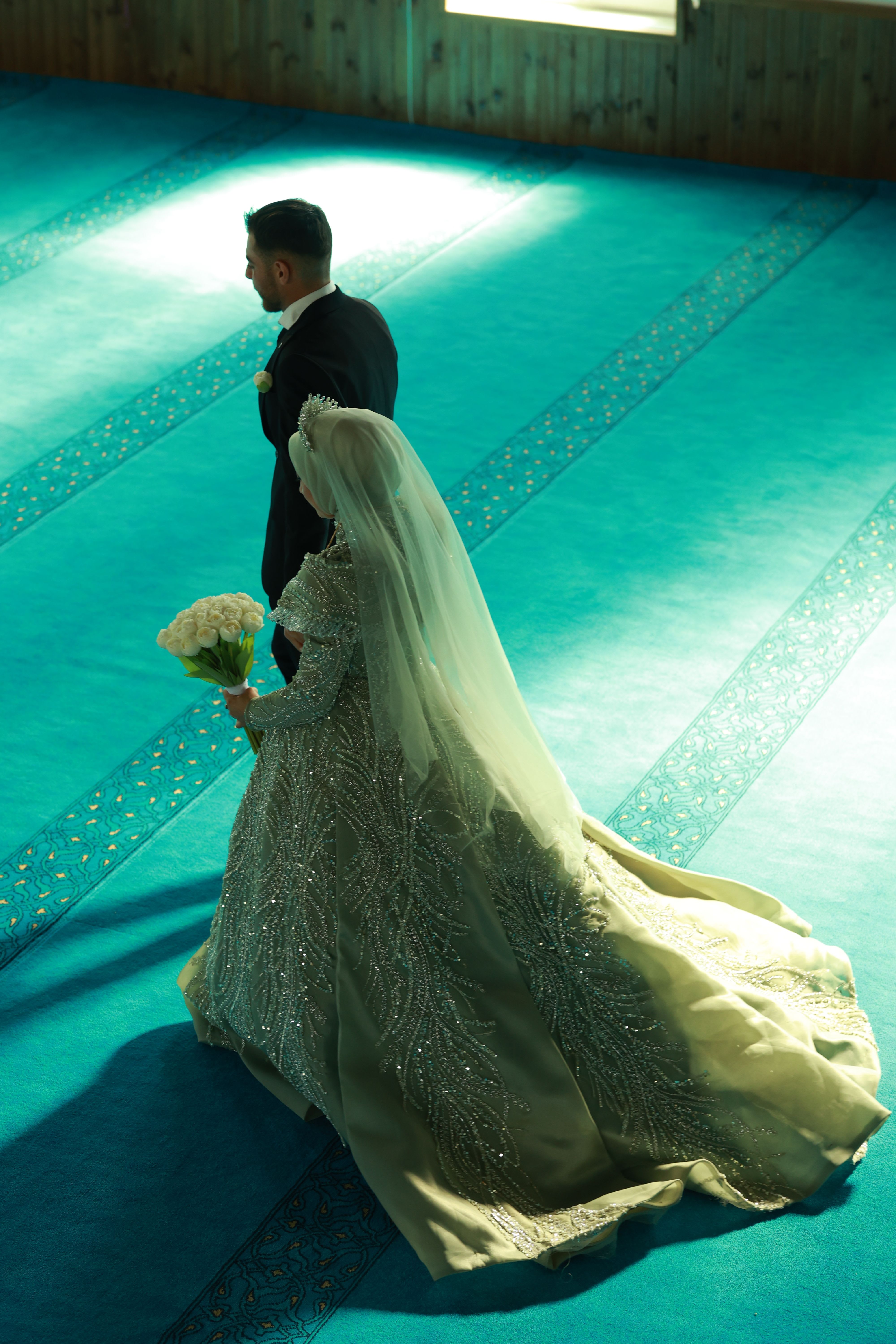

Every Muslim man looking for a wife has a list.
Sometimes it's written down. More often it lives in his head — a collection of qualities assembled over years from family expectations, cultural norms, community conversations, and his own sense of what he wants. Pretty. Practicing. Educated but not too ambitious. Close to her family. Good cook. Soft-spoken. Compatible background.
The list is not wrong, exactly. Some of those things matter. But the list has a problem: it describes a profile, not a person. And a profile is not what you will actually be married to.
You will be married to a human being — fully formed, complex, sometimes difficult, often surprising — who will sit across from you at breakfast for forty years. Who will see you at your worst and choose you anyway. Who will carry your children, grieve your losses, challenge your assumptions, and build something with you that neither of you could build alone.
The question is not "does she match my list?" The question is "is she someone I can build a real life with?"
Those are different questions. And the second one requires different criteria.
Key Takeaways
- The Prophet ﷺ gave specific guidance on what to prioritise in a wife — and most men have misunderstood it
- Deen as the primary criterion is not about surface religiosity — it is about character that is rooted in genuine faith
- The qualities that actually sustain a marriage are observable — but rarely visible in a formal rishta meeting
- How a woman treats people who can do nothing for her is one of the most reliable character indicators available
- Soul Deeds creates contexts where these qualities become visible before any formal commitment
What the Prophet ﷺ Actually Said — And What It Really Means
The most quoted hadith on choosing a spouse is this:
"A woman is married for four things: her wealth, her family status, her beauty, and her deen. Choose the one with deen — may your hands be blessed." (Bukhari and Muslim)
This hadith is cited constantly. It is also frequently misapplied.
"Choose the one with deen" is not a simple instruction to find the most visibly religious woman. It is a profound guidance about what actually carries a marriage. And understanding what deen means in this context — what it looks like in practice, how you recognise it, how it differs from religious performance — is the most important work any Muslim man can do before he starts seriously looking.
("Deen" in this hadith refers not merely to religious practice — prayer, hijab, halal food — but to the entire orientation of a person's character toward Allah. It encompasses honesty, patience, mercy, gratitude, humility, and the way someone treats others when no one important is watching. A woman who prays five times a day but is cruel to her household staff, dismissive of people below her, or dishonest in small things has religious practice without the deen the Prophet ﷺ was pointing to.)
Quality 1: Deen That Shows in Her Character, Not Just Her Practice
The woman you want to marry prays — but that is not what tells you about her deen.
What tells you is what she is like when she thinks no one important is watching.
How does she treat the waitress who got the order wrong? How does she speak about people who aren't in the room? Is she patient with someone who is slow, difficult, or inconvenient? Does she volunteer because she genuinely wants to serve, or because it looks good on a matrimonial profile?
These are not peripheral questions. They are the central ones. Because the woman whose deen is real — whose faith has actually shaped her character and not just her appearance — is the woman who will bring that same patience, that same mercy, that same genuine goodness into your home, your children's upbringing, and the hardest seasons of your shared life.
Religious practice is visible in a formal meeting. Character rooted in genuine faith is not. Seek the second, and you will have found the first.
("A 2024 Yaqeen Institute survey found that Muslim men cited 'strong deen' as their top priority in a spouse — but when asked to define what they meant, over 70% described external religious markers like hijab and prayer rather than character qualities like honesty, patience, or genuine service to others. The gap between what men say they want and what they know how to look for is significant.")
Quality 2: Emotional Maturity — Not Just Emotional Pleasantness
There is a version of the "good wife" ideal that is really just a request for someone who is always pleasant, never difficult, and never requires anything emotionally demanding from her husband.
That is not emotional maturity. That is emotional suppression — and it tends to surface, eventually, in ways that are far more difficult than the original discomfort would have been.
Emotional maturity looks like this: she can identify and communicate what she feels without it becoming an accusation. She can receive feedback without shutting down or becoming defensive. She can sit with difficulty — her own and yours — without immediately needing it resolved. She repairs after conflict. She does not punish with silence or escalate with drama.
("Research published in the Journal of Family Psychology (2022) found that emotional maturity — specifically the ability to regulate emotions during conflict — was the single strongest predictor of marital satisfaction at the five and ten year marks, outperforming compatibility of values, shared interests, physical attraction, and family background.")
You are not looking for someone who never has difficult emotions. You are looking for someone who has a mature relationship with them.
How do you assess this before marriage? Look for consistency between her formal and informal self. How does she handle small frustrations? How does she talk about people who have hurt her — with proportionality and perspective, or with a bitterness that hasn't moved? Does she take responsibility for her own mistakes, or does she consistently locate the problem outside herself?
Quality 3: Genuine Kindness to People Who Can Do Nothing for Her
This is the quality that is most reliably predictive of long-term marital character — and the one that is least visible in a formal rishta setting.
How does she treat the elderly aunt nobody pays attention to at a family gathering? The child who keeps interrupting? The volunteer coordinator who is frazzled and not handling things well? The service worker whose job it is to be invisible?
("The way a person treats those who hold no social value — no power, no connection, nothing to offer — is consistently described in organisational psychology research as the most reliable single indicator of character. The same principle, applied to marriage, predicts the kind of spouse someone will be in the ordinary, unglamorous seasons of a long life together.")
A woman who is warm and attentive in front of the rishta meeting and dismissive in the car ride home is showing you something true. A woman who brings the same genuine warmth to everyone — the impressive and the invisible — is showing you something more valuable than anything she could say about herself.
This quality is almost impossible to perform consistently over time. It is either there or it isn't. And it is visible — if you know to look for it, and if you put yourself in settings where it has the chance to appear.
Quality 4: Honesty — Even When It Is Uncomfortable
The rishta process has a well-known problem: both parties are on their best behavior, presenting the most appealing version of themselves, and the result is that you often learn who someone really is only after the nikkah.
One of the most reliable antidotes to this is to look for someone who is honest even when honesty is uncomfortable.
Does she tell you things you might not want to hear — about herself, about her concerns, about the process — or does she manage your impression of her carefully? Does she acknowledge her own limitations with self-awareness, or does she present an unbroken highlight reel? Can she disagree with you directly, or does she smile and comply in the moment and express the disagreement in other ways?
("Ibn Qayyim al-Jawziyyah writes in Rawdat al-Muhibbin that a person's honesty in small matters is the most reliable indicator of their honesty in significant ones. A woman who cannot be honest about small preferences, small mistakes, or small discomforts during courtship is unlikely to suddenly become honest about larger ones after marriage. The habit of honesty is built in the small moments.")
A woman who is genuinely honest — who can tell you something difficult with kindness, who acknowledges her flaws without excessive self-deprecation or defensiveness — is a woman you can actually trust. And trust is what a marriage is built on.
Quality 5: A Relationship With Allah That Is Her Own
This is distinct from religious practice, and the distinction matters enormously.
There are women who are religiously practicing because their family is, because their community expects it, because it is part of their cultural identity. And there are women whose relationship with Allah is genuinely their own — cultivated through personal prayer, personal reflection, personal tawbah, personal seeking.
The second group is who you are looking for. Not because the first group is insincere — many people begin with inherited faith and deepen into personal faith over a lifetime — but because a woman whose deen is personally owned, not just culturally inherited, brings something specific and irreplaceable to a marriage and to the raising of children.
How do you tell the difference? It is not in what she does but in how she talks about it. Does she speak about her faith with personal depth — about what it means to her, what it has cost her, what it has given her? Or does she speak about it in the language of obligation and performance?
Does she make dua for things that are genuinely personal — that she hasn't been told to pray for by anyone else? Does she have a relationship with the Quran that is her own — that she returns to for comfort and guidance, not just for recitation? Does she take tawbah seriously — not as a theological concept but as a lived practice?
("Research by the Institute for Social Policy and Understanding (2023) found that Muslim women who described their religious practice as personally meaningful — rather than culturally expected — reported significantly higher marital satisfaction, stronger communication with their spouses, and more resilient responses to marital difficulty. Personal faith, not just practiced religiosity, was the differentiating factor.")
Quality 6: Respect for Your Role Without Diminishing Her Own
Islam establishes a structure in marriage — the husband as the leader of the household, the wife as his partner in that leadership. This structure is not about hierarchy of worth. It is about clarity of function.
The woman you want to marry understands and respects this structure — not because she has been told to, but because she understands its wisdom. And she brings her own full self within that structure rather than either resenting it or disappearing into it.
This means she respects your leadership without needing to perform compliance. She is a genuine partner — with her own perspective, her own contribution, her own voice — who also understands the Islamic framework within which that partnership operates.
("The most durable Islamic marriages, across cultures and generations, share a common feature: the wife is neither subordinated into passivity nor elevated above the structure Islam has established. She is a full person within a clear framework. Finding a woman who holds both her own dignity and genuine respect for Islamic marriage structure is not a contradiction — it is the Prophetic model, demonstrated most clearly in the Prophet ﷺ's own marriages.")
Quality 7: How She Handles Hardship
Marriage will bring hardship. There is no version of a long shared life that does not. Financial difficulty. Loss. Illness. Seasons of distance. Children who bring their own complexity. The ordinary accumulation of disappointment that living a real life produces.
The woman you want to marry is not someone who has never struggled. She is someone who has struggled and shows you something worth respecting in how she has responded to it.
Does she carry difficulty with sabr — genuine patience, not performance? Does she have gratitude that persists even when things are hard? Does she seek Allah when things go wrong, or does difficulty push her away from her faith?
You will not see this in a formal rishta meeting. You will see it in the stories she tells about her own life — what she learned, how she changed, what she is still working through. You will see it in how she responds to inconvenience and disappointment during the courtship process itself. You will see it in whether the version of her you encounter when things go slightly wrong is still someone you want beside you.
Why These Qualities Are Rarely Visible in a Formal Rishta
Everything in this article points toward the same problem: the qualities that actually matter in a wife are almost entirely invisible in the format most Muslim men use to evaluate one.
A formal rishta meeting is designed for first impressions. It surfaces manners, self-presentation, stated values, and family background. It does not surface character under pressure, genuine kindness to strangers, emotional maturity in conflict, personal depth of faith, or how someone handles hardship.
To observe those things, you need a different context — one where both people are genuinely themselves, doing something real, without the performance pressure of a formal evaluation.
This is why Soul Deeds' Community Giving Circle model matters for Muslim men specifically. When you volunteer alongside someone — pack meals, sort donations, show up for a community that needs something — you get access to the information that a dozen rishta meetings cannot give you.
You see how she treats people who can do nothing for her. You see whether she does the unglamorous work without needing recognition. You see how she handles the small frustrations of a communal effort. You see whether the warmth she shows in public is the same warmth she shows when no one is watching.
You see her character — before the commitment, when it still matters most.
Frequently Asked Questions
Is beauty a valid consideration when looking for a wife in Islam?
Yes — the hadith itself mentions beauty as one of the four things a woman may be married for. Physical attraction between spouses is acknowledged and encouraged in Islam. What the Prophet ﷺ cautioned against was prioritising beauty above deen — not including it as a consideration at all. A man who is genuinely attracted to his wife, and a woman who is genuinely attracted to her husband, is a Sunnah-aligned situation. The problem is when attraction is the primary criterion and character is secondary.
Should I look for someone from the same cultural background?
Cultural compatibility can reduce friction — shared assumptions about family involvement, communication styles, and life expectations are genuinely useful. But cultural background is not a substitute for character compatibility, and many of the most serious marital problems occur between couples who shared every cultural marker and nothing deeper. Weigh it as one factor among many, not as a primary criterion.
What if I feel attracted to someone but she doesn't fully meet my religious standards?
This requires honest self-assessment on two questions: first, are your religious standards accurate reflections of what Islam actually requires, or are they cultural expectations labelled as religious ones? Second, is the gap in religious practice something that is growing — she is developing in her deen — or something static? A woman who is on a genuine journey of faith, even if she hasn't arrived at every destination, may be a better long-term partner than one who performs religiosity without genuine personal faith.
How do I know if her good behaviour during courtship is genuine or performed?
Look for consistency across contexts — between the formal and informal, the observed and the unobserved. Performance tends to be effortful and context-specific. Genuine character tends to be consistent. The informal moments — how she responds to something unexpected, how she treats peripheral people, how she speaks when she thinks the evaluation is over — are your most reliable data points. This is exactly why community service settings, where the performance pressure is lower and the real context is higher, give you better information than formal rishta meetings.
Is it wrong to want an educated, ambitious wife?
No — and any cultural messaging that suggests a woman's education or ambition makes her less suitable as a wife has no basis in Islamic scholarship. The Prophet ﷺ was surrounded by educated, accomplished, opinionated women — Khadijah (RA) was a businesswoman, Aisha (RA) was a scholar, Umm Salamah (RA) was a political advisor. A woman's excellence in the world does not diminish her as a wife. In most cases, it makes her a better one.
Conclusion
The checklist is not useless. But it is incomplete.
The man who marries well is not the man who found the woman who matched every item on his list. He is the man who knew what actually mattered — who looked past the profile to the person, past the presentation to the character, past the formal meeting to the real human being — and found someone whose genuine self was someone he wanted to spend his life beside.
Deen that shows in character. Emotional maturity. Genuine kindness to everyone. Honesty even when it costs her. A faith that is personally hers. Respect without diminishment. Grace under hardship.
These are the qualities worth looking for. They are not easy to find in a formal rishta process. But they are visible — if you know where to look, and if you put yourself in the right settings to observe them.
Soul Deeds was built for exactly that — genuine character, visible in real action, before any formal commitment is made.