
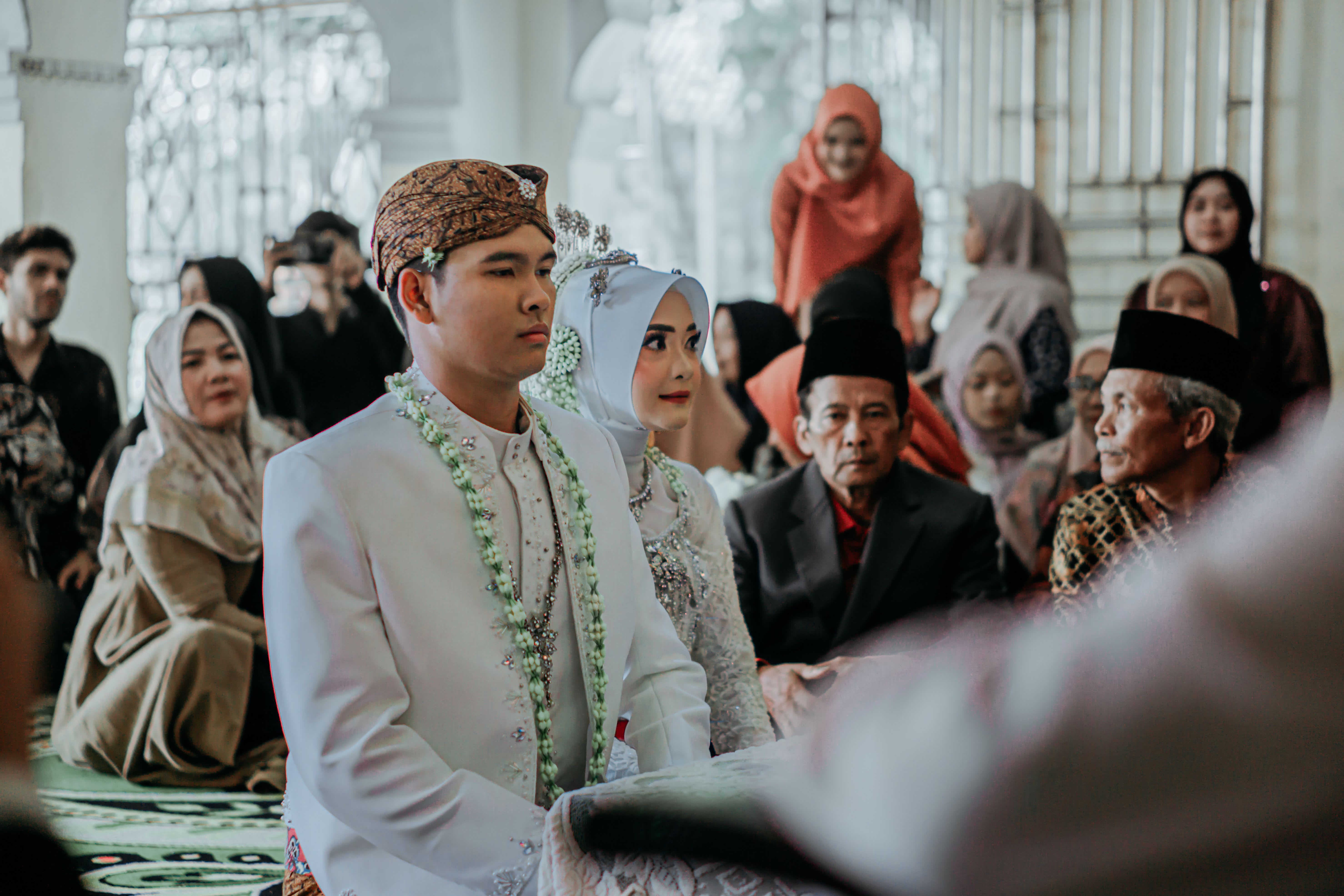

A woman's wali for nikah is typically her closest Muslim male relative — her father first, then her paternal grandfather, then her full brothers, then her half-brothers, then her paternal uncles, in that order of precedence. If no eligible male relative is available — because they are non-Muslim, deceased, absent, or unreasonably refusing — an imam or Islamic authority serves as wali in their place. The Prophet ﷺ said: "The sultan is the wali of the one who has no wali." (Abu Dawud, Tirmidhi)
What is the order of wali in Islamic law?
The order of wilayah — guardianship — for a woman's nikah follows a defined sequence across the major schools of Islamic jurisprudence, with minor differences in ordering between them.
The general sequence agreed upon by the majority of scholars:
1. Father — the primary and strongest wali. His guardianship takes precedence over all others when he is alive, Muslim, of sound mind, and not in a state of ihram.
2. Paternal grandfather — steps in when the father is deceased, absent, or otherwise unavailable. In the Maliki school, the father may override the grandfather's decisions if he returns. In the Shafi'i and Hanbali schools, the grandfather holds an independent and strong position.
3. Full brother — both parents shared. Takes precedence over half-brothers.
4. Half-brother — paternal side only (same father, different mother).
5. Paternal uncle — the father's full brother, then the father's half-brother.
6. Son of the paternal uncle — first cousins on the father's side, in order of closeness.
7. More distant male relatives — following the same logic of paternal lineage.
8. The Islamic authority — an imam, scholar, or judge — when no eligible relative exists or when the existing relatives are unable or unwilling to fulfil the role appropriately.
("The Maliki school differs from the others in one significant respect: it gives the mother's side of the family no role in wilayah at all, while the Hanafi school's position that an adult woman may contract her own nikah effectively makes the entire sequence advisory rather than obligatory. Ibn Rushd documents these differences in Bidayat al-Mujtahid, noting that the disagreement reflects a genuine difference in how scholars weighed the various hadiths on wilayah against each other — not a difference in values, but in textual interpretation.")
Can my mother be my wali?
No — across all four major Sunni schools, wilayah for nikah is a right held by male relatives only. A mother, maternal aunt, sister, or any female relative cannot serve as wali for a nikah, regardless of how close the relationship or how absent the male relatives are.
This is not because female relatives are considered less trustworthy or less loving. Classical scholars explain wilayah as a specific legal function — tied to the Islamic framework of male financial responsibility and legal standing in family matters — rather than a measure of the quality of the relationship.
If no male relative is available, the function passes to an Islamic authority — an imam or judge — not to female relatives.
What if my father is not Muslim?
A non-Muslim cannot serve as wali for a Muslim woman's nikah. This is the position across all major schools without disagreement.
If a woman's father — or any male relative in the sequence — is not Muslim, his position in the order of wilayah is skipped entirely. The guardianship passes to the next eligible Muslim male relative in the sequence.
If all of her male relatives are non-Muslim, or if she has no male relatives at all, an imam or Islamic authority serves as her wali. This is not an exceptional or unusual arrangement — it is a standard provision within Islamic law, and many imams in Western countries regularly perform this function for Muslim women in exactly this situation.
("The ruling that a non-Muslim cannot serve as wali for a Muslim woman's nikah is documented without disagreement across all classical fiqh texts. Al-Nawawi in Al-Majmu states it as a condition with complete scholarly consensus. The reasoning given by classical scholars is consistent: the wali's function is to act in her Islamic interest — a function that requires Islamic values and Islamic accountability. A non-Muslim wali, however loving, cannot be held to Islamic standards of fulfilment of that function.")
What if my father refuses to be my wali?
If a wali refuses to approve a suitable marriage without valid Islamic reason — what scholars call 'adl, or unjust withholding — his guardianship can be transferred.
The process is: the right of wilayah passes to the next eligible relative in the sequence. If that relative is also unwilling, it passes further down the line. If no eligible relative will fulfil the role appropriately, it passes to an Islamic authority — an imam or judge.
Valid Islamic reasons a wali may decline include: the proposed husband has poor character or weak deen, there is a genuine risk of harm, or the man demonstrably cannot fulfil his financial obligations. These are protective functions — using the wali's role as it was designed.
Invalid reasons include: tribal or ethnic prejudice, financial considerations unrelated to the husband's ability to provide, caste expectations, family politics, or personal preference without Islamic basis. A wali who withholds approval for these reasons has become 'adl — unjust — and Islamic law does not allow him to hold the process hostage.
The Prophet ﷺ said: "If someone whose deen and character you are pleased with comes to you, marry them. If you do not, there will be fitnah on earth and widespread corruption." (Tirmidhi, authenticated) Scholars cite this hadith directly in the context of a wali who unreasonably blocks a suitable match.
("A practical note for Muslim women in Western countries navigating an unwilling wali: the standard Islamic guidance is to first seek a trusted Islamic scholar or imam to speak with the wali directly. In many cases, a respected religious authority can mediate effectively where direct conversation has not. If the wali remains unreasonably obstinate after this, the imam who mediated may himself offer to serve as wali — fulfilling both the mediation and the guardianship function simultaneously. This is a well-established practical pathway documented in contemporary Islamic legal responses.")
Can an imam be my wali?
Yes — and this is one of the most important provisions in Islamic law for Muslim women who need it.
An imam serving as wali is not a workaround or a lesser option. It is a formal, classically established function. The hadith is direct: "The sultan is the wali of the one who has no wali." (Abu Dawud, Tirmidhi) In the absence of a state Islamic authority in Western countries, scholars consistently hold that a local imam or recognised Islamic scholar fulfils this function.
The imam serving as wali should ideally be someone with knowledge of Islamic family law, standing in the community, and the willingness to take the role seriously — including asking appropriate questions about the proposed husband's character and deen, not simply signing off on any request brought to him.
("Contemporary Islamic scholars including Sheikh Yasir Qadhi and the European Council for Fatwa and Research have addressed the wali question for Western Muslim women extensively. The consistent position: an imam who is knowledgeable and trusted within his community has both the right and the responsibility to serve as wali for women who have no eligible Muslim male relative. This is not a modern accommodation — it is classical Islamic law applied to a modern context.")
Soul Deeds provides access to imams and Islamic advisors through in-app booking. For women who need guidance on wali arrangements — whether navigating an absent father, a non-Muslim family, or an unreasonably refusing relative — these advisors can help identify the right path forward and, where appropriate, serve in that capacity themselves.
What if I was raised without a father and have no male relatives?
This is a situation many Muslim women — particularly reverts and those from non-Muslim families — navigate, and Islamic law addresses it clearly.
If a woman has no Muslim male relatives at all, she is not without recourse. She is not prevented from marrying. The wali function passes entirely to an Islamic authority — the local imam or a recognised Islamic scholar she trusts and whose standing in the community is established.
For reverts specifically: the imam of the mosque where a woman took her shahada, or the Islamic center most associated with her reversion, is the natural starting point for this conversation. Many mosques have specific provisions for this situation and imams experienced in fulfilling the wali role for women in these circumstances.
The wali for a revert Muslim woman should be someone who:
- Has knowledge of Islamic family law and the nikah process
- Knows enough about the proposed husband — or is willing to ask — to fulfil the protective function wilayah is designed for
- Will be present at or formally represented at the nikah itself
- Can be genuinely accountable to the community in that role
Does my wali have to be present at the nikah in person?
The majority scholarly position is that the wali — or his formally appointed representative — must be present at the nikah for the ijab and qabul to be valid.
A wali who cannot attend in person may appoint a wakeel — a proxy — to represent him at the nikah. This is a well-established provision. The proxy must be a Muslim man of good character, formally appointed by the wali with clear verbal or written authorisation, and must fulfil the role as the wali's representative — not in his own capacity.
Contemporary scholars have addressed remote participation — video call presence — in cases where physical attendance is genuinely impossible. Most allow it under strict conditions: the wali must be able to see and hear the proceedings clearly in real time, all parties must be identified, and the connection must be uninterrupted during the ijab and qabul. A recorded video or a message sent in advance does not fulfil the presence requirement.
("The Maliki school is the strictest on physical presence, generally not accepting proxy or remote arrangements without strong necessity. The Hanafi and Shafi'i schools have broader allowance for proxy representation, provided the conditions of formal appointment are clearly met. If your wali cannot attend in person, consulting a scholar from your madhab about the specific arrangements is essential before proceeding.")
Frequently Asked Questions
Can my older brother be my wali if my father is alive? Not while your father is alive and able to fulfil the role — a living, Muslim, competent father takes absolute precedence in the Maliki, Shafi'i, and Hanbali schools. Your brother would only serve as wali if your father has passed away, is incapacitated, is non-Muslim, or has formally delegated the role to him.
Can my wali force me to marry someone I do not want? No. A wali who uses his position to force a woman into a marriage she genuinely does not consent to has exceeded his Islamic authority. The Prophet ﷺ explicitly gave women the right to refuse marriages their fathers had contracted without their consent — and voided such marriages when they were brought to him. The wali's role is protective, not controlling. Force nullifies the nikah.
What if my wali approves someone I do not want to marry?
The wali's approval does not override your consent. Both are required. A wali may approve a proposal; you may still decline. The wali's function is to evaluate and protect — not to decide in your place. No valid Islamic marriage requires the bride's consent to be replaced by her wali's.
Is Soul Deeds a dating app?
No. Soul Deeds is a Muslim matrimonial platform for people seriously seeking marriage. Members are verified, and connections form through shared community service projects rather than swiping.
Can I find an imam through Soul Deeds to serve as my wali? Soul Deeds provides in-app booking with Islamic advisors — imams and scholars — who can provide guidance on wali arrangements and, where appropriate, discuss serving in that capacity. Every situation is different and deserves personalised Islamic guidance.
Is Soul Deeds free? Yes — Soul Deeds is free to join, on iOS, Android, and the web.